
U-value, G-value, and the New Building Regulations

Our previous post covered what the Future Homes Standard changes at the regulatory level. This one looks at what’s changing about the calculation itself: what now goes into it, what comes out of it, and where current practice is most likely to fall short.
Three input streams, three suppliers
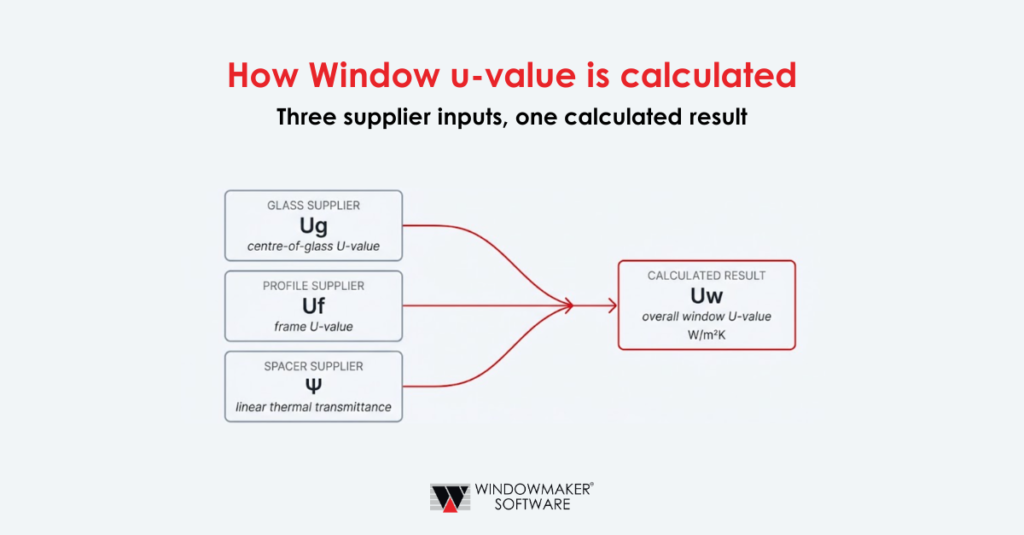
The overall window U-value (Uw) on your quote is built from three inputs. Ug comes from your glass supplier. Uf comes from your profile supplier. Ψ, the linear heat loss at the spacer, comes from your spacer supplier, or a calculation on the specific frame/glass combination. The calculation methods ADL1:2026 references are BS EN ISO 10077-1 and 10077-2.
In practice, the calculation is only as good as the worst input in it. If your Ug is current but your Uf is two years out of date, the result is wrong in ways the number itself won’t reveal. If a spacer supplier hasn’t published a Ψ matrix for a particular frame system, the calculation can’t complete cleanly and most reputable software will return “not known” rather than guess. Both gaps tend to surface late, in the middle of a quote, when the housebuilder is already waiting for an answer.
The methodology change isn’t difficult in principle. The difficulty is that the inputs come from three different supply chains, each with their own publishing schedule, and the fabricator sits at the junction where any missing piece becomes their problem.
What “area-weighted dwelling-level” actually means
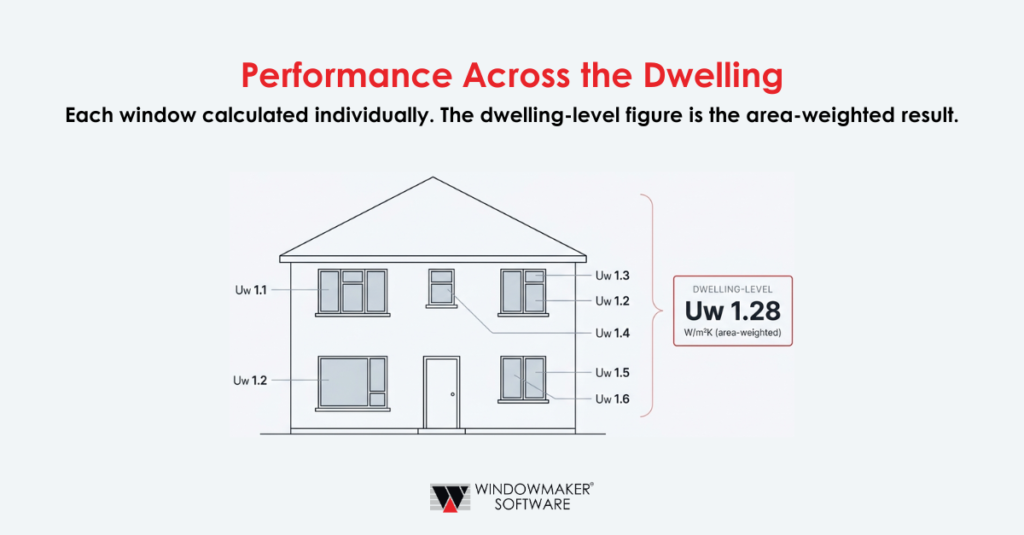
The first post mentioned that performance is now assessed across the dwelling, as an area-weighted average. Worth unpacking what that looks like on a real quote.
A house might have ten openings: large picture windows on the south face, smaller bathroom and stairwell windows elsewhere, a glazed back door. Under the new methodology, each is calculated against its actual size and configuration. The dwelling-level number is the area-weighted average of all of them.
This gives you headroom and constraint at the same time. A stronger window on the south face can offset a weaker one in the bathroom, but only if the maths rolls up cleanly to a dwelling-level Uw that holds against the limiting standard and supports the target rates. Quoting window by window isn’t enough. The fabricator who can show the rollup on the quote is solving a problem the housebuilder is about to inherit.
G-value: the second number
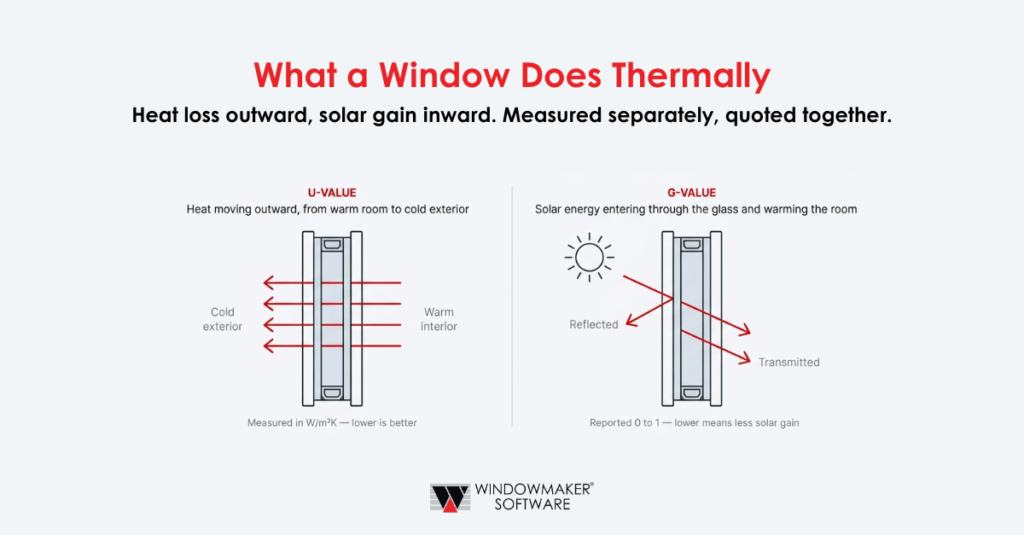
G-value is the fraction of solar energy hitting the outside of the window that ends up as heat inside the room, reported as a decimal between 0 and 1. It’s been on glass datasheets for years. What’s changed is that the Home Energy Model behind ADL1:2026 now uses it.
HEM models solar gain alongside heat loss when checking whether a dwelling meets its target emission and primary energy rates. A window with very low solar transmission can hurt the model in winter, when free solar gain would have been doing useful heating work. A high-transmission window can cause overheating in summer in well-insulated south-facing rooms.
The architect or HEM modeller decides the right balance. But they need both numbers from you to make that decision.
The Ug / G tradeoff
This is the bit that’s about to become a working conversation between fabricators and specifiers.
Glass specification decisions affect both numbers, and rarely in the same direction. A switch from a standard low-E coating to a solar-control coating reduces G-value, which helps on south-facing elevations but cuts useful solar gain elsewhere. A switch from double to triple glazing reduces U-value and G-value at the same time, which can be the right answer or the wrong one depending on orientation.
Specifiers used to ask for “a 1.2 window.” From 2027, the conversation will sound more like “a 1.2 window with a G-value above 0.45 for the south elevation, below 0.35 for the west.” Fabricators who can quote against both numbers, against the actual window configuration, will be the ones housebuilders trust and go forwards with. Quoting just U-value will start to look thin.
What this means in practice
Nothing in the calculation itself is conceptually new. The components have been around for years. What’s changed is that they all now have to be in the same place, current, and rolled up against the actual configuration of the window the customer is asking for.
For fabricators, the practical shift is not so much about learning new physics and actually about making sure the quoting process can carry both numbers on every line. The conversations housebuilders and specifiers are about to start having will begin to assume that as a baseline.
For the regulatory background, our earlier post on the Future Homes Standard covers the dates and what’s changing. If you’d like to talk through how any of this lands on your current quoting setup, we’re here for that too.