
The Future Homes Standard: What It Means for UK Window and Door
A practical guide to what’s changing, when, and what to do about it.
If you fabricate windows and doors for the UK new-build market, the rules you’ve been working under are about to change. The legislation is on the books, the dates are now fixed, and most of the trade coverage so far has focused on what isn’t changing. The targets you’ve been working to are the same. What’s changed is everything underneath them.
This blog post covers what’s actually changing at the regulatory level, the dates that matter, and what we’d suggest doing now.
What the law actually says
On 24 March 2026, the UK government laid the Building Regulations etc. (Amendment) (England) Regulations 2026, also known as Statutory Instrument 2026/335. Alongside it came new versions of Approved Document L (energy and greenhouse gas emissions) and Approved Document F (ventilation). Together these implement the Future Homes Standard in England.
Scotland, Wales, and Northern Ireland have their own building regulation frameworks. The timing and specifics differ, but the same shift is coming across the UK: more detailed thermal calculation, per-configuration assessment, less reliance on standard reference figures. Wales has confirmed its own Approved Document L 2026, coming into force on 4 March 2027, covering both energy performance and greenhouse gas emissions.
That’s the legal backbone. Everything else follows from it.
Three dates worth pinning above your desk
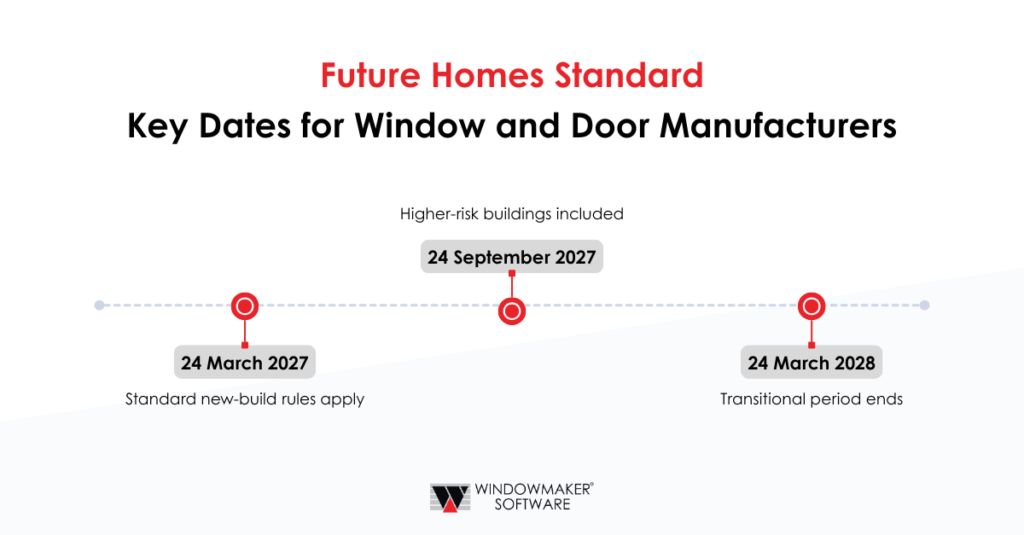
The regulations don’t all come into force at once. There are three dates that matter for anyone fabricating into the new-build market.
24 March 2027. The new rules apply to standard new-build work in England. From this date, building notices, initial notices, and full plans applications submitted on or after 24 March 2027 fall under the new ADL1:2026.
24 September 2027. The same rules apply to higher-risk building work, typically tall residential blocks. The six-month gap is a deliberate phasing to give the HRB sector time to adjust.
24 March 2028. This is the cliff edge. For projects that filed under the old rules before 24 March 2027, the building work has to have commenced before 24 March 2028 to keep transitional protection. After that, even projects with older approvals fall under the new standards.
A trap inside the transitional rules
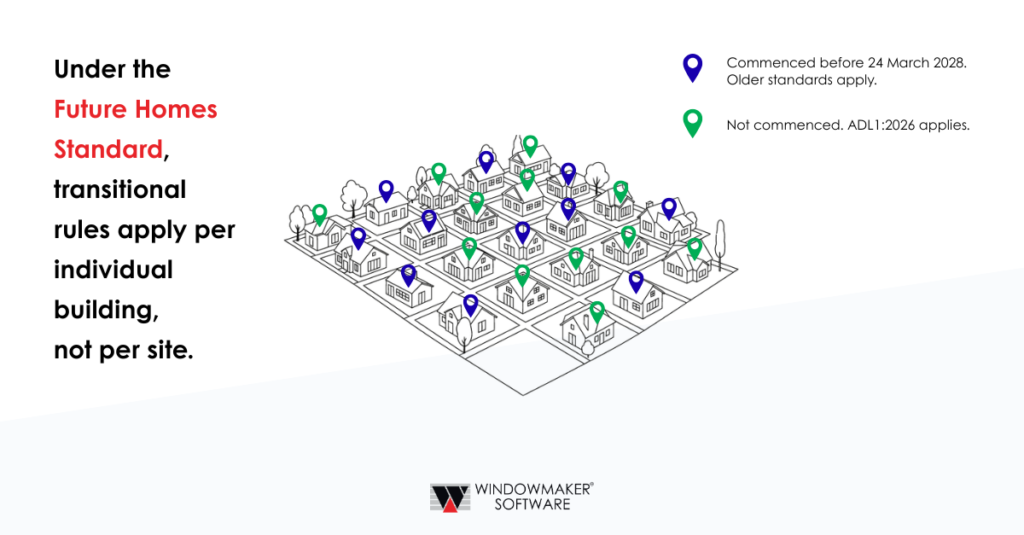
The transitional provisions apply per individual building, not per site.
On a multi-house development, only the individual plots that meet the commencement conditions before 24 March 2028 can use the older standards. The rest fall under ADL1:2026, even if they share an application reference with their neighbours.
For a window manufacturer quoting into a phased development, that creates a real question. Your housebuilder customer might be working off a single specification document. The reality is that some plots in that development will need older-spec windows and others will need new-spec windows. Asking which ADL applies to which plot, plot by plot, is going to become a normal part of new-build conversations.
It’s worth raising this question now with the housebuilders you supply. The ones who haven’t thought about it yet will appreciate you flagging it. The ones who have will respect that you’re paying attention.
What the Future Homes Standard changes for windows and doors
The headline U-value targets haven’t moved. The limiting U-value, the worst any individual opening can be, stays at 1.6 W/m²K for both windows and doors. The notional dwelling spec used inside the energy model assumes 1.2 W/m²K for windows and glazed doors, and 1.0 W/m²K for other doors. [Source: ADL1:2026, Table 3.1 (limiting U-values) and notional dwelling specification]
In plain English: the bar hasn’t been raised, but the way you have to prove you’ve cleared it has changed. Three things specifically:
One: the standard reference window is gone for new dwellings. Until now, you could calculate U-value once against a 1230 × 1480 mm reference window and apply that figure across the range. Under the new regs, every window in a new dwelling must be determined either by hot-box measurement or calculated using the actual size and configuration of the window . The reference-window route survives only for existing dwellings. [Source: ADL1:2026, paragraphs 3.2 and 3.4]
Two: ancillary components now count. The calculation has to include all the parts of the opening that affect thermal performance. The new regs set out exactly what must be included in a new-dwelling U-value calculation: actual frame sections, sills and thresholds, frame extenders and add-ons, dummy sashes, dummy transoms and mullions, decorative glazing bars within the unit cavity (Georgian bars, duplex), and non dead-load-bearing coupling components such as PVC H-couplers. Dead-load-bearing components — bay poles being the regulation’s named example — are excluded.
The practical effect is that anything materially affecting the thermal envelope is in scope, and the calculation can’t be done from a profile datasheet in isolation. [Source: ADL1:2026, paragraph 3.3]
Three: performance is assessed across the dwelling, not per window. The limiting U-values are explicitly defined as “area-weighted average values”. A stronger window can offset a weaker one within the same dwelling, provided the calculation rolls up cleanly to a dwelling-level number that holds against the limiting standard and supports the target emission, primary energy, and fabric energy efficiency rates. [Source: ADL1:2026, Table 3.1 and Note 1]
Why this matters more than it might sound
A few practical consequences flow from this.
Most real-world windows are smaller than the old 1230 × 1480 reference. Smaller windows have proportionally more frame, which makes 1.2 W/m²K harder to hit. Add a Georgian bar, a dummy sash, or a coupler, and you reduce the glazed area further. Some configurations that passed under the old methodology may not pass under the new one. [Source: GGF; Eurocell technical commentary]
It means standard double-glazed configurations that have been routine for years could fall short on certain real-world window sizes. The likely market response, already being predicted by industry bodies, is a wider shift toward triple glazing on new-build to give the calculation more headroom. [Source: GGF, Eurocell]
For a fabricator, that means the quoting process needs to do more work earlier. You can’t quote a U-value off a datasheet. You have to calculate it for the configuration the customer is actually asking for, and you have to see the rollup across the whole quote to know whether the dwelling will pass.
What the wider regulatory change tells you about direction
Two smaller changes in the legislation are worth noting because they signal where the regulations are heading.
The heading of Part L in Schedule 1 to the Building Regulations has changed, from ‘Conservation of fuel and power’ to ‘Energy and greenhouse gas emissions’. The Approved Document title follows suit. The functional requirement itself now reads that ‘reasonable provision must be made for conservation of fuel and power and minimisation of greenhouse gas emissions’ . [Source: FHBS Circular 01/2026, Annex A]
It’s a wording change, but the wording change matters. Part L is no longer just about energy use. It’s now explicitly targeting carbon emissions. For ten years, fabricators have sold thermal performance as an energy-efficiency story. From March 2027, you’ll be selling it as a carbon story as well. That changes the conversation with architects, with housebuilders, and probably with end customers within five years.
There’s also a new functional requirement, L3, which introduces a requirement for renewable electricity generation for new dwellings and buildings containing dwellings. [Source: S.I. 2026/335, regulation 3; FHBS Circular paragraph 10] In practice that means heat pumps and solar PV become standard rather than optional. Windows in those homes are working harder, because the heating system is less tolerant of thermal weak points than gas central heating was. A poorly performing window has more impact on a heat-pump-heated home than on a gas-heated one.
Neither of these directly changes the maths of a U-value calculation. They change the context the calculation lives in. Thermal performance is becoming a more visible part of the dwelling’s overall energy story, not a tucked-away product specification.
What we’d suggest doing now
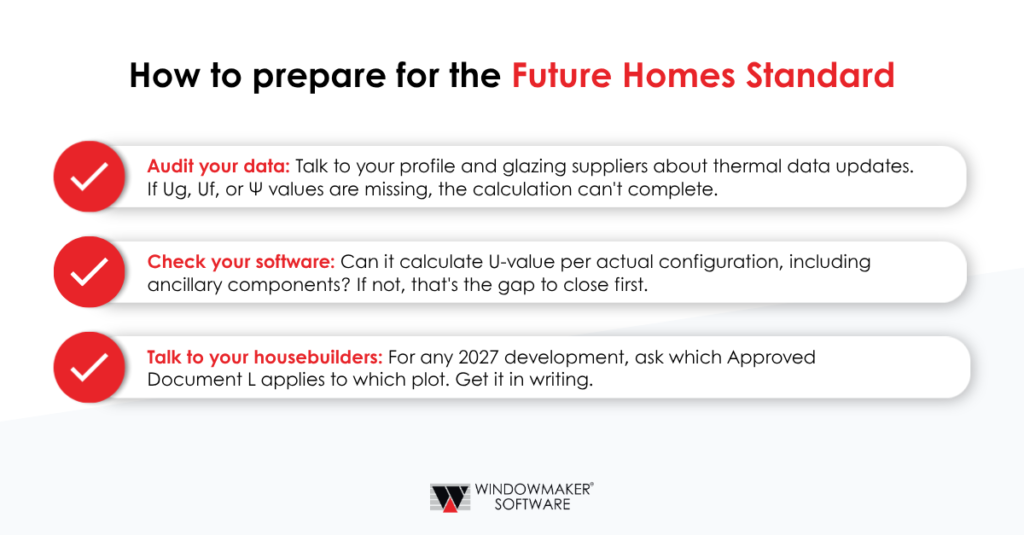
You don’t need to panic. You do need a plan. Three practical things worth starting on this quarter.
Audit your current data. The new methodology depends on accurate Ug, Uf, and Ψ values for every glass spec, profile cutlet, and spacer combination you use. If those values are missing, inconsistent, or out of date, the calculation will produce gaps before it produces compliance. Start the conversation with your profile and glazing suppliers about updated data, and make sure what you have is current.
Check what your software actually does. If you rely on standard reference window calculations today, the gap to ADL1:2026 is bigger than it might look. The question is whether your quoting tool can calculate U-value per actual configuration, including ancillary components, and whether the result holds up under the new methodology.
Have the conversation with your housebuilder customers. For any 2027 development you’re quoting into, ask which Approved Document L applies to which plot. Get it in writing. The customers who haven’t thought about it will appreciate the prompt. The ones who have will note that you’re ahead of the curve.